LoRaWAN, explained simply.
A long-range, low-power radio network that lets thousands of small sensors report readings across an entire industrial site — without a single cable.
Think of LoRaWAN as a private, low-power radio network built just for sensors. Instead of Wi-Fi, which is fast but short-range and power-hungry, LoRaWAN sacrifices speed for range and battery life — a sensor only needs to send a tiny reading every few minutes, so it can run for up to ten years on one battery and still be heard from kilometres away.
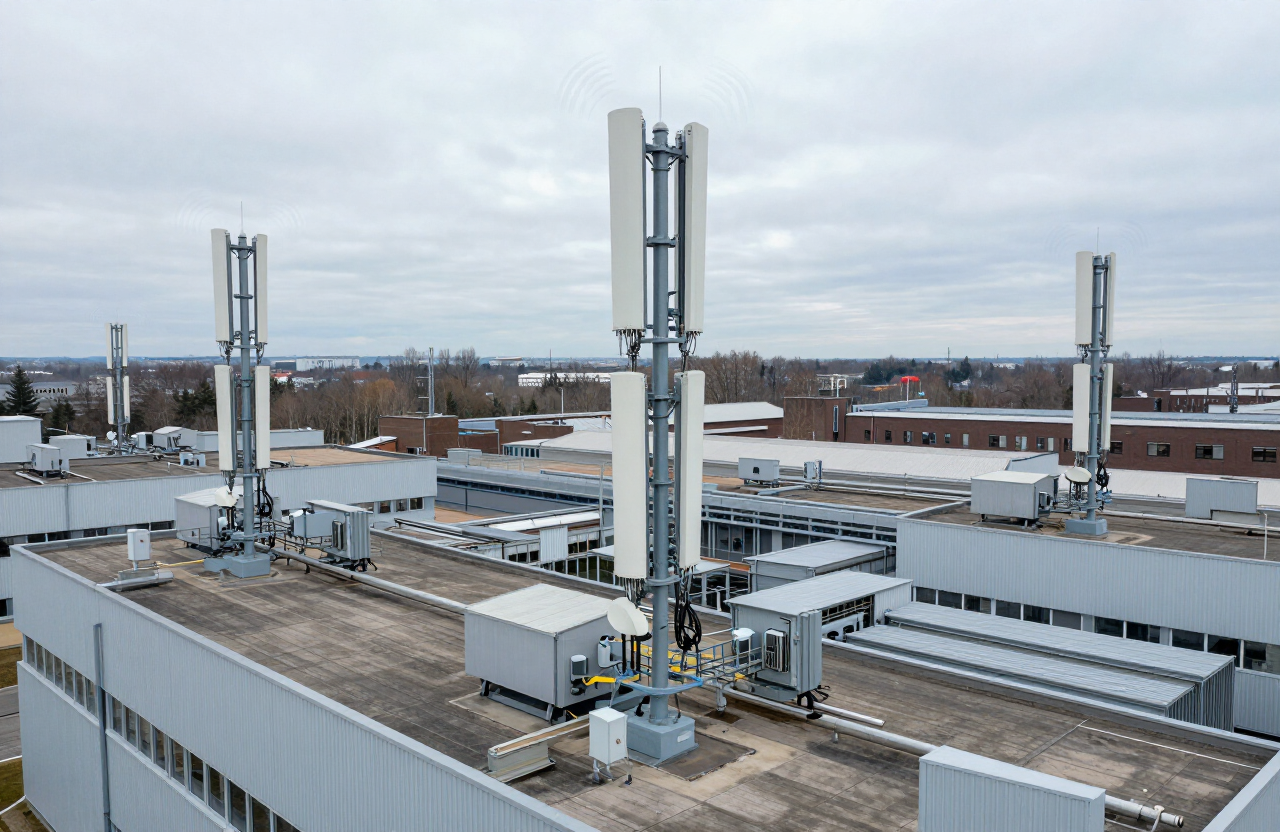
LoRaWAN (Long Range Wide Area Network) is the radio backbone underneath almost everything we deploy. It is what allows a handful of gateways to hear thousands of sensors spread across sprawling industrial estates, ports and distribution centres, without trenching a single cable.
Key benefits
- No cabling or building work to deploy sensors
- Coverage across an entire estate from a handful of gateways
- Up to ten years of sensor battery life
- An open standard with no single-vendor lock-in
A simple diagram of the data path.
How a reading gets from a machine to your dashboard.
Sensor
Reads a value (e.g. current draw) and radios it out
LoRaWAN network
Carries the reading up to 15km, through walls and steel
Gateway
Listens for thousands of sensors and forwards data securely
Cloud platform
Stores, analyses and visualises the reading
Dashboard
Your team sees it live, on any device
Why not just use Wi-Fi or 4G?
Wi-Fi and cellular are built for streaming video and browsing — they trade battery life for speed. Industrial sensors send a tiny packet of data occasionally, so LoRaWAN's trade-off (slower, but years of battery life and far greater range) is a better fit.
Range
A single gateway can hear sensors up to 15km away in open ground, and reliably through dense industrial buildings.
Battery life
Because it only "wakes up" briefly to transmit, a sensor can run for up to a decade on one battery.
Capacity
One gateway can support thousands of sensors, so scaling to a whole estate rarely means adding much hardware.
An open standard, not a walled garden
LoRaWAN is governed by an open industry alliance rather than a single vendor, which matters when you are committing to infrastructure that will run for a decade.
No vendor lock-in
Sensors and gateways from different manufacturers can share the same network.
Private networks
Your site's network is your own — data never touches a shared public network.
Common questions
Still unsure? Our engineers are happy to talk through the detail for your estate.
All FAQsIs LoRaWAN secure?
Yes. Every message is encrypted end-to-end with AES-128, so readings cannot be read or spoofed in transit.
Does it work indoors?
Yes. LoRaWAN penetrates walls, floors and steel structures far better than Wi-Fi, though very large sites may need more than one gateway.
How is this different from Bluetooth?
Bluetooth covers metres, LoRaWAN covers kilometres. Bluetooth suits a phone pairing with headphones; LoRaWAN suits a sensor on the far side of a warehouse.
Explore what connects to this.
Ready to make your estate measure itself?
Request an infrastructure audit and we will design a LoRaWAN energy-monitoring programme built for ISO 50001 readiness across the UK and Europe.
Choose how you would like to engage our team.
Every route below reaches our UK and EU enterprise engineers directly. Pick the one that fits where you are — no obligation, response within one working day.
Common questions
An engineer reviews your metering estate and site plans, then returns a scoped monitoring proposal — typically within one working day of the initial call. There is no cost or obligation.
Send an enquiry
Tell us about your estate and we will route you to the right engineer.